
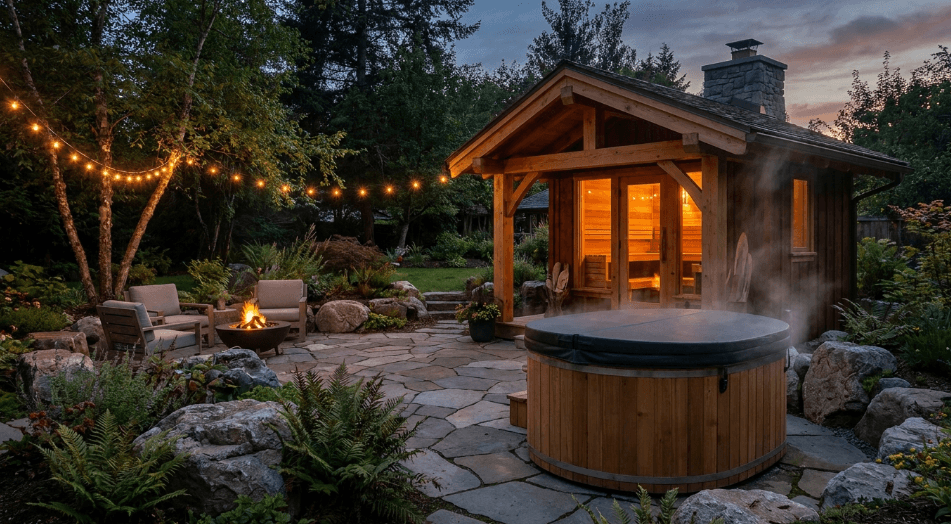
Does a Sauna Add Value to Your Home in a Small Space?

A sauna rarely returns its full cost the way a kitchen or bathroom remodel does, but in a small home it earns its footprint back in a different way: it turns an unused corner, closet, or strip of patio into a feature buyers actually notice on a walkthrough. Appraisers generally treat a sauna as a personal-use amenity rather than a line item with a set dollar value, which means the return depends heavily on the market, the install quality, and whether the space it occupies had any other realistic use to begin with.
Does a Sauna Actually Raise a Home’s Appraised Value?
Most licensed appraisers do not assign a fixed dollar figure to a sauna the way they might for an added bedroom or an extra half bath. It gets folded into the general condition and amenity score of the property, alongside things like a finished basement or a covered patio. Where it does move the needle is buyer perception during a showing, particularly in cold-climate regions, ski towns, and dense urban markets where a sauna reads as a wellness amenity rather than a novelty. A real estate agent working a listing in Minneapolis or Denver will talk about a backyard cabin sauna very differently than one working a listing in Phoenix, where the same unit might barely register with buyers.
Condo and townhouse developments add another wrinkle worth knowing before installing one in a small unit. A sauna built into a shared amenity space, rather than a private one, does not attach to any single unit’s value at all, and a private in-unit sauna in a building without amenity space of its own can be a genuine differentiator on a listing. Buyers shopping small urban units increasingly search filters for “sauna” or “spa amenity” the same way they search for in-unit laundry, which matters more for how quickly a home sells than for the final sale price itself.
Which Sauna Types Actually Work in a Small Home?
Space is the real constraint for most homeowners considering this project, and the sauna market has responded with compact options. An infrared cabin can fit in a footprint as small as 3 feet by 4 feet, small enough for a corner of a garage, a closet conversion, or a slice of an existing deck. It runs cooler than a traditional sauna, generally 120 to 150 degrees Fahrenheit, and many two-person units plug into a standard 120-volt outlet rather than requiring new wiring. A compact outdoor barrel sauna, built around a curved stave shell roughly 6 to 7 feet in diameter, uses less floor area than a rectangular cabin of the same interior volume because the round shape sheds unusable corner space, though it does need a level pad and typically a dedicated 240-volt circuit once you get into a heater above 6 kilowatts.
What Makes a Small-Space Sauna Read as a Real Feature, Not a Squeezed-In Box?
The details that separate a sauna buyers notice from one they walk past are mostly about finish and placement. Tongue-and-groove cedar or Nordic spruce paneling with no visible fasteners looks intentional in a way that a vinyl-wrapped box does not. Placement matters just as much: a unit tucked into a dead corner of a yard with a small gravel or paver pad reads as landscaping, while one dropped in the middle of an otherwise usable patio reads as clutter. Interior bench layout should account for actual room use, an L-shaped bench frees floor space in a tight cabin better than two parallel benches. Ventilation, a vapor barrier behind the paneling, and a properly sized heater all affect how the unit performs over years, which matters more to a future buyer than it might seem at the time of installation, because a sauna that smells musty or never gets hot enough reads as a liability rather than an amenity.
What Should a Small-Space Sauna Cost, Unit to Install?
A small indoor infrared cabin generally runs $2,000 to $3,500 for the unit itself, often without any electrical work if it uses a standard outlet. A compact outdoor traditional cabin or barrel sauna typically lands between $4,500 and $7,500 once a heater, delivery, and basic electrical work are factored in, though a dedicated 240-volt circuit run from a panel that is far from the install site can add meaningfully to that number. Buyers comparing options across specialty retailers should look past sticker price to wood species, heater wattage relative to interior volume, and stated warranty length, since those three factors predict how long the unit lasts more reliably than the listed price does. SweatDecks lists model specs including cubic footage and heater kilowatts side by side, which is the comparison that actually matters for a small footprint where every cubic foot of interior space affects heat-up time and running cost.
Does Regular Sauna Use Actually Support the Investment?
Buyers researching a sauna purchase often ask whether the health case holds up, and the honest answer is that it holds up as association, not proof. A 2018 review in Mayo Clinic Proceedings summarized research linking frequent sauna use with favorable cardiovascular markers across multiple studies. An older review in The American Journal of Medicine reached similar conclusions while also cataloging real contraindications, including caution for anyone with unstable cardiovascular conditions. A more recent 2023 Mayo Clinic Proceedings review looked at sauna bathing alongside other lifestyle factors and found the combination, not sauna use alone, tracked with the strongest associations. None of this is proof that installing a sauna improves any one person’s health outcomes, and a buyer weighing the investment should treat it as one wellness habit among several, not a medical intervention.
Frequently Asked Questions
Does a home sauna increase resale value? It rarely returns its cost dollar for dollar, but in cold-climate and wellness-focused markets it works as a differentiator that can shorten time on market. Appraisers typically treat it as a personal-use amenity rather than a fixed line item.
What size sauna fits a small home? A compact infrared cabin can fit a footprint as small as 3 feet by 4 feet. A two-person traditional cabin usually needs closer to 4 by 5 feet plus clearance for the heater and door swing.
How much does a small-space sauna cost installed? A small indoor infrared cabin generally runs $2,000 to $3,500. A compact outdoor traditional cabin or barrel unit typically lands between $4,500 and $7,500 once a heater, delivery, and basic electrical work are included.
Do buyers actually care about a home sauna? In cold-climate and dense urban markets, a well-built sauna is increasingly noted as a selling point, similar to a hot tub. In warmer, more casual markets it draws less attention.
References
- Cardiovascular and Other Health Benefits of Sauna Bathing: A Review of the Evidence, Mayo Clinic Proceedings, 2018
- Benefits and risks of sauna bathing, The American Journal of Medicine, 2001
- Does the Combination of Finnish Sauna Bathing and Other Lifestyle Factors Confer Additional Health Benefits? A Review of the Evidence, Mayo Clinic Proceedings, 2023